

When investing in Cotswold stone construction, it’s important to understand proper maintenance and care. This is a key factor in preserving the heritage of the area’s natural building materials, which are still in use today, as well as preserving your property against early deterioration. Mistakes in maintaining Cotswold stone can lead to worsening problems, as this material is so different from other building materials in its chemical makeup.
What Is Cotswold Stone and Why It Needs Specialist Care
Cotswold stone is a traditional building material used in central England in areas around the Cotswolds such as Gloucestershire, southern parts of Warwickshire and Oxfordshire. It has been used for hundreds of years, with stones mined for rural cottages, drystone walling and regency palaces alike. Prized for its honey-like colour, this stone varies greatly in quality from seam to seam, with browner tones in north Oxfordshire and grey stones in north Gloucestershire.
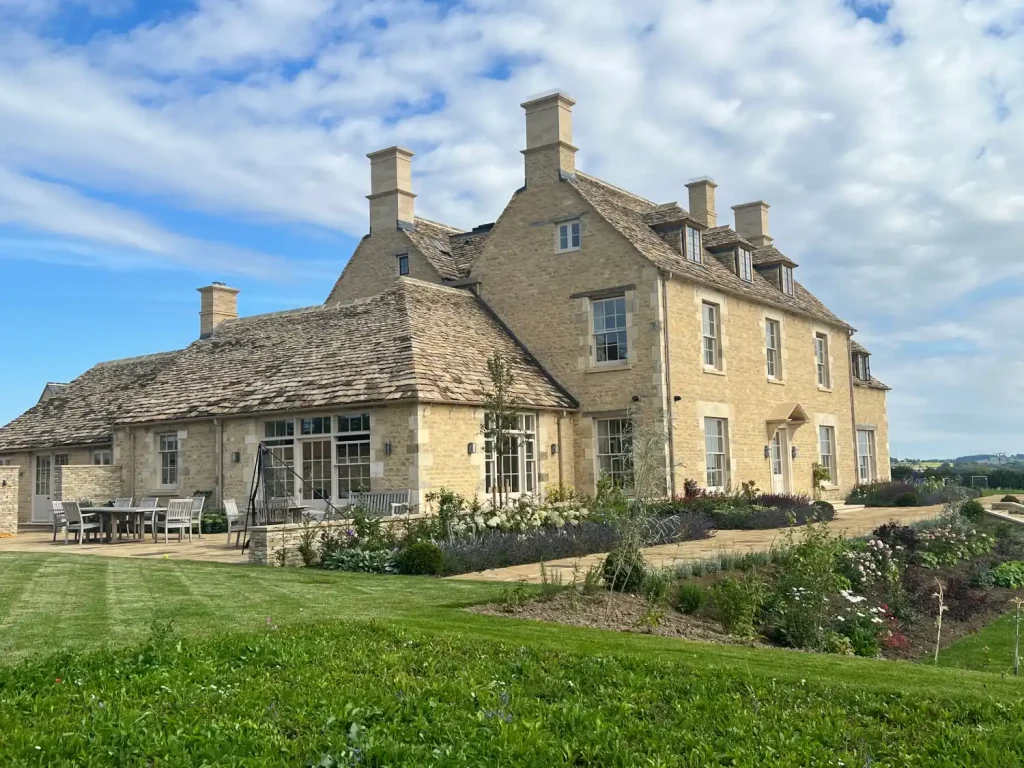
The mines tap into thin strata of “oolitic limestone”, which is a sedimentary rock with a high calcite composition. It formed millions of years ago from sand particles and calcites from early crustacean shells, bound together with lime mud in the shallow tropical waters of the Jurassic period. This is the stone that the Cotswold hills are formed from, with tiny spheres or oolites embedded in the stone.
Because of the high calcite content and porosity, Cotswold stone is vulnerable to erosion from water and acidic compounds. Traditionally, cottages were protected with a limewash coating, which was mixed with additives such as linseed oil or tallow. Limewashing was carried out at regular intervals to preserve the stone and create a water-resistant layer over the surface.
Common Issues Affecting Cotswold Stone Over Time
Weathering and Erosion
Traditional Cotswold buildings were built to protect the walls from heavy rain by overhanging thatched roofs and limewash. However, more modern buildings face problems as late Victorian builders recreated modern shapes in Cotswold stone. Particular problems arise around damaged drainpipes and blocked gutters, as consistent wetting causes the stone to decay. Walls should be able to dry out fully, but where they are grown over with ivy or moss, or near heavy vegetation, they can remain damp for prolonged periods, causing problems.
As with all natural stone and concrete buildings, frost can have a big impact. However, because Cotswold stone is so porous, it is much more susceptible to freeze-thaw weathering, which can cause large cracks as absorbed water expands.
Biological Growth (Moss, Algae, Lichen)
Walls that have absorbed water and remain damp over time provide a perfect environment for algae and moss to form and spread. These plants, along with lichen, are often the first stage of transforming rocky islands into lush vegetation and will breed on the walls of your house if not removed promptly. Shaded and north-facing walls are most vulnerable as they are less able to dry off in the sun.
When moss or algae builds up, more moisture is held in the stone, causing long-term deterioration.
Pollution and Staining
As limestone is alkaline, it is easily damaged by acidic substances such as acid rain pollution and diesel fumes. This results in a chemical reaction in the surface of Cotswold stone and other limestones, forming a black crust of sulphate or nitrates.
Rusting iron or steel fixtures can also lead to staining, as the red iron oxide or rust is washed onto the stone and absorbed by the pores.
Best Practices for Routine Maintenance of Cotswold Stone
Gentle Cleaning
Restoration starts with careful cleaning. Use distilled water and a soft brush to remove any sulphate layers, moss, lichen or algae. Avoid using abrasive methods such as sandblasting or jet washing, as these will erode the surface of the soft limestone. Low pressure water cleaning with a hose and a brush can be effective – but avoid waterlogging the stone.
This cleaning can be carried out every six months to a year. Avoid cleaning too frequently, as you’re trying to avoid soaking the stones.
In some cases, an herbicide can be applied to stop the growth of algae or moss. Use these sparingly, as runoff into the ground can damage plants.
Limewashing Cotswold Stone
Limewash is a mixture of calcium hydroxide or quicklime and water that creates an antifungal, insect-repelling and breathable layer across the stone. Lime draws moisture out of stone, so it is excellent for preserving Cotswold stone buildings. Pigments can be added, made from minerals, to recreate the desired colour, as limewash is bright white without a pigment. Additives of linseed oil can thin the limewash and improve its water-resistance.
Traditionally, limewash was applied to Cotswold stone buildings regularly to protect the stone, with a variety of colours employed. It fell out of fashion in the early 1900s, leaving many traditional stonework buildings exposed to decay.
Limewash is still a viable method of maintaining Cotswold stone and is seeing a resurgence in some areas as a method of reducing repair costs.
Seasonal Maintenance Tips
We advise making checks in spring and autumn around the perimeter of the building to inspect all areas of the stone. Pay particular attention to areas under gutters, around drainpipes and at the corners of the building.
Clear gutters every six months to prevent overflows that could cause severe degradation. Make sure drainage is clear to avoid standing water near the walls.
Make any roofing repairs promptly to address problems with water runoff.
What to Avoid When Maintaining Cotswold Stone
During limestone building maintenance, make sure you are aware of the properties of the stone before choosing your materials and methods. Limestone is alkaline, so any acidity can cause chemical reactions that degrade the stone. Make sure you avoid:
- Acidic detergents or cleaning products
- Abrasive methods such as sand blasting and jet washing
- Harsh chemicals such as bleach or ammonia
- Water saturation, as this can lead to frost damage
Repointing and Repairs: Preserving the Integrity of Cotswold Stone
Importance of Lime Mortar Over Cement
In the last hundred years, problems have arisen as repairs and repointing has been quickly done with cement mortar. Unfortunately, the hard, dense cement mortar accelerates the degradation of Cotswold stone.
Because the stone is porous, it must be able to breathe and release moisture from every angle. Because cement is not breathable, it holds the moisture inside the stone, causing the surface to flake away. This can only be repaired with resurfacing, which is expensive, or limewashing.
Traditional pointing for Cotswold buildings was made from lime mortar, often made from sand, burnt limestone and local lime clay. Lime mortar, like limewash, is breathable and allows moisture to evaporate easily. It is also more visibly compatible with traditional buildings than cement.
Signs Your Stonework Needs Repointing or Repair
In many cases, the mortar joints between stones have deteriorated over time. You may notice crumbling mortar, cracks in the stone, flaking surfaces, damp patches, loose stone or voids.
Mortar joints should be removed carefully and replaced with lime mortar, or a mix which matches the original. It should be flexible and porous so that water can escape without causing damage.
This same compound can be used to fill small cracks or voids in the stone, matching texture and colour as closely as possible.
In severe cases, such as large cracks, crumbling or flaking that continues throughout the stone, it is possible to replace individual stones. Ideally, replacements will match the colour, grain and composition of the originals. They’ll be cut precisely and sealed with a suitable mortar.
Preserving Cotswold Stone for Generations to Come
Maintaining Cotswold stone buildings must be done carefully and with respect to the unique material to avoid causing further damage. Using traditional methods is an excellent way to learn from our forebears and preserve the heritage of the area. Cranatt Construction is a dedicated team of craftspeople, focused on keeping Cotswold stonemasonry skills alive in a modern building industry. The longevity of the buildings we erect depends on the maintenance that they receive over time, so we are more than happy to advise or carry out restorations as needed. Simply contact us on the phone or by email and we’ll answer any further questions about Cotswold stone maintenance you have.